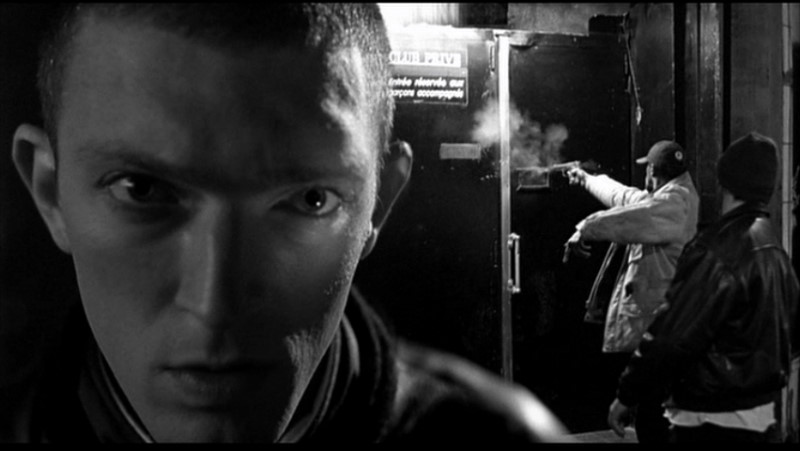
Here is the first section of Hip Hop: Beyond Beats and Rhymes. Click on the video so that it opens up in YouTube and you will find the other 5 parts (for a total of 6). Enjoy.
Tuesday, November 16, 2010


Sunday, November 7, 2010
New Media: Convergence Culture & Collective Intelligence

Jenkins, "Worship at the Altar of Convergence"
Jenkins, "Spoiling Survivor"
from Convergence Culture
Manovich, "Principles of New Media"
from The Future of Ideas
Himanen, "From Netiquette to Nethic"
from The Hacker Ethic
Acculturation I: La Haine
 Yun Kim, "Adapting to a New Culture"
from Samovar et al., Intercultural Communication: A Reader; 12th Edition
Habermas, "Leadership and Leitkultur"
Hall, "Who Needs Identity?"
For our discussion of Kassowitz's La Haine/Hate:
Siciliano, "La Haine: Framing the 'Urban Outcasts'"
Brooks, "Gangsta, in French" from The New York Times Op-Ed Page
Rosen, "David Brooks: Playa Hater" from Slate.com, a response to Brooks
Below you can also find Etienne Balibar's now classic article on the 2005 banlieue revolts:
Etienne Balibar, "Uprisings in the Banlieues"
Saturday, October 30, 2010
The Halloween Special

The Misfits - Halloween
The Cramps - Goo Goo Muck
The Sonics - The Witch
Suicide - Ghost Rider
X - Hungry Wolf
Iggy & The Stooges - Search and Destroy
Screamin' Jay Hawkins - I Put A Spell On You
Iggy & The Stooges - Search and Destroy
Screamin' Jay Hawkins - I Put A Spell On You
Gravediggaz - 2 More Cups of Blood
Misfits Two-Times:
The Misfits - Mommy, Can I Go Out and Kill Tonight (Live)
Horror Story:
Dead Boys - Ain't It Fun
Extra Scary Bedtime Story:
Thomas Brinkmann - Paris/Texas
Misfits Two-Times:
The Misfits - Mommy, Can I Go Out and Kill Tonight (Live)
Horror Story:
Dead Boys - Ain't It Fun
Extra Scary Bedtime Story:
Thomas Brinkmann - Paris/Texas
Monday, October 25, 2010
The Social Construction of Race, Part Deux

This is the bulk of readings for the 'discourses of race' section of the course as we wade through it this week and next. Please have these articles read in the order posted. Pay particular attention to Zook's article on the Fox Network as it invests that political economic perspective that is so well dramatized in Bamboozled as well as the Means-Coleman article on 'black sitcoms' which is a good example of textual analysis.
Kristal Brent Zook, "The Fox Network and the Revolution in Black Television"
Robin R. Means-Coleman, "Black Sitcom Portrayals"
Donald Bogle, "Workplace Dramas, Ensemble Casts 1990s Style"
Chyng Fen Sun, "Ling Woo in Historical Context: The New Face of Asian American Stereotypes on Television"
The Social Construction of Race I

This a short introductory article on race and the media. As we conclude screening Bamboozled and discuss the film, Ash Corea's "Racism and the American Way of Media" is a good summary of the issues raised in the film and those that you will be reading about in greater detail with the next group of articles. As a bonus, a classic article by Stuart Hall.
Ash Corea, "Racism and the American Way of Media" from Questioning the Media
Stuart Hall, "What is This 'Black' in Black Popular Culture" from Stuart Hall: Critical Dialogues in Cultural Studies
Clip from a 1949 film, Hollywood Varieties, where actors Glenn Vernon and Edward Ryan apply blackface make-up while on stage and reminisce about 'the good ol' days' --as they say-- of ministrelsy.
European Art Cinema

Ingmar Bergman's Persona (Sweden, 1966)
Sunday, October 24, 2010

Sunday, October 17, 2010
Language and Cultural Values
 Samovar, "Language and Culture: The Essential Partnership"
Samovar, "Nonverbal Communication"
Samovar, "Venturing Into A New Culture"
from Samovar et al, Communication Between Cultures, 7th Ed (Wadsworth, 2009): Chapters 6,7 & 11
Gannon, "Understanding Cultural Metaphors"
from Understanding Global Cultures, 4th Ed. (Sage, 2010): Chapter 1
Friday, October 15, 2010
Study Guides: Race & Gender + Intro to Cinema
After the wise and profound words of Father Guido here's the much agonized for Study Guides:
Race and Gender
Intro to Cinema
Wednesday, October 13, 2010
Cinematic Specificity

Pee Wee's Big Adventure, The Greatest Bicycle Thief Homage Produced by Hollywood
(Please read only the articles on De Sica and The Bicycle Thief)
Below you will also find, embedded, Bazin's 'The Virtues and Limitations of Montage' from What is Cinema?; Vol I --click on the Google Books logo at the bottom of the frame and a new tab will open with a more comfortable page size for reading.
Below you will also find, embedded, Bazin's 'The Virtues and Limitations of Montage' from What is Cinema?; Vol I --click on the Google Books logo at the bottom of the frame and a new tab will open with a more comfortable page size for reading.
Vsevolod Pudovkin, "On Editing" from Film Technique
Sergei Eisenstein, "The Cinematographic Principle and the Ideogram" + "A Dialectic Approach to Film Form" from Film Form
Sergei Eisenstein, "The Cinematographic Principle and the Ideogram" + "A Dialectic Approach to Film Form" from Film Form
The 'Odessa Steps' sequence in Sergei Eisenstein's Battleship Potemkin (USSR, 1925)
referred to in the "A Dialectic Approach to Film Form" article above.Emancipatory Uses of the Media

Here are the new readings: Please find below Hans Magnus Enzensberger's "Constituents of a Theory of the Media" together with an article over viewing 'radical media' in Italy and the use of new communication technologies by political movements during the late '60s and '70s. This last article should accompany your viewing of Marco Tullio Giordana's I Cento Passi and provide you with context (both for the film itself and the historical period in which Enzensberger wrote the 'Constituents' article). The Hesmondalgh is an article attempting to define and focus the feature of 'alternative' and 'radical' media.
Something to think about in relation to the film is how Peppino Impastato's attempts at carving out a space for communication and direct political action (a public sphere within the confines of a small community dominated by organized crime) is dramatized in the film --from traditional political rallies to 'free radio', after navigating dadaist street theater, pamphleteering, film screenings and be-ins. Think specifically of the characteristics of RadioAut --programming, control, voice, 'mission', etc. Does the 'network' finally deliver on those expectations?
Enzensberger - Constituents of a Theory of the Media
Downing - Radical Media in Italy
Friday, October 8, 2010
New Media: The Internet As Technology

Jeremy G. Butler, "The Internet and the World Wide Web"
P. David Marshall, "The Internet: The Multi-Media Accessible Universe and the User"
Bolter & Grusin, "The World Wide Web" (from Remediation)
P. David Marshall, "The Internet: The Multi-Media Accessible Universe and the User"
Bolter & Grusin, "The World Wide Web" (from Remediation)
Thursday, October 7, 2010
Visual Pleasure and Narrative Cinema: Psychoanalytic Feminist Film Theory
 "Woman as image, man as bearer of the look"
 Otto Preminger's Laura (1944)
Laura Mulvey, "Visual Pleasure and Narrative Cinema"
You can also find it in html format here.
Saturday, October 2, 2010
New Media: Gaming
 Pac-Man Skull
These are two articles on videogames and their history. Use them in conjunction with the screening of Game On: The Unauthorized History of Video Games screened in class.
Bolter & Grusin, "Computer Games" (from Remediation)
P. David Marshall, "Playing Game Cultures: Electronic Games"
Super Mario 25th Anniversary
Subscribe to:
Posts (Atom)


 Posts
Posts