Day, Ethics and Society (Chp. 2 of Ethics in Media Communication; Wadworth, 2006)
Day, Ethics and Moral Reasoning (Chp. 3 of Ethics in Media Communication; Wadworth, 2006)
Johnson, Ethical Perspectives (Chp. 1 of Organizational Ethics: A Practical Approach; Sage, 2011)
Please watch the following, famous episode of Ellen's coming out aired on ABC in 1997. Consider questions of content and 'ratings'. Be ready to discuss the ethical implications of airing the episode on mainstream broadcast television. Be prepared to discuss your reasoning and perspective.
Tuesday, October 11, 2011


Visual Pleasure and Narrative Cinema: Psychoanalytic Feminist Film Theory
 "Woman as image, man as bearer of the look"
Otto Preminger's Laura (1944)
Laura Mulvey, "Visual Pleasure and Narrative Cinema"
You can also find it in html format here.
This is the article that failed to post relating to the readings assigned for Week 4:
Jean Kilbourne, “The More You Subtract, the More You Add: Cutting Girls Down to Size”
Wednesday, October 5, 2011
Construction and Performance II: Masculinities

Eminem, Lose Yourself
Brian Locke, "Here Come The Judge: The Dancing Itos and the Televisual Construction of the Enemy Asian Male"
Gail Dines, "King Kong and the White Woman: Hustler Magazine and the Demonization of Black Masculinity"

Harold & Kumar
Monday, October 3, 2011
New Media: The Internet as Technology

Jeremy G. Butler, "The Internet and the World Wide Web"
P. David Marshall, "The Internet: The Multi-Media Accessible Universe and the User"
Bolter & Grusin, "The World Wide Web" (from Remediation)
P. David Marshall, "The Internet: The Multi-Media Accessible Universe and the User"
Bolter & Grusin, "The World Wide Web" (from Remediation)
Thursday, September 29, 2011
Corporate Media, Regulation and Taking Back The Media

In the readings below you can find a good summary of the ideas that we have been debating in class around the organization of media systems, their ability to serve the public good and the resistances to regulation. Many of you have encountered these ideas in your other media studies classes but this is as good a moment as any to go over them in the systematic manner in which these readings do. LINKS ARE NOW FIXED
McChesney, Corporate Media and the Threat to Democracy
Sanders, "Why Americans Should Take Back The Media"
Spence et al, "The Business of the Media and the Business of the Market"
Anthology of articles from The Future of the Media
Bonus: After yesterday's screening follow this link and take the BBC's Silvio Berlusconi Birthday Quiz. After all it was his birthday yesterday. Then you can watch Lloyd Kaufman on media consolidation below.
Wednesday, September 28, 2011
New Media: Gaming
 Pac-Man Skull
These are two articles on videogames and their history. Use them in conjunction with the screening of Game On: The Unauthorized History of Video Games screened in class.
Bolter & Grusin, "Computer Games" (from Remediation)
P. David Marshall, "Playing Game Cultures: Electronic Games"
Super Mario 25th Anniversary
Thursday, September 22, 2011
Media Law and Codes of Ethics

Here is the link for Poynter's Online Media Law short course. The readings on media reform will be posted tomorrow evening. Below you can also find two Codes of Ethics, one for Journalists and one for Marketers. Please be ready to discuss these in class on Tuesday along with the other readings.
The Poynter course is at: http://tinyurl.com/39ejw9x
Journalism Code of Ethics: http://tinyurl.com/ylfb554
Marketers Code of Ethics: http://tinyurl.com/yktg9pq
Monday, September 19, 2011
Text and Context: Political Economy & Reception
 Janice Radway, "Women Read The Romance: The Interaction of Text and Context"
Jan Nederveen Pitersem, "White Negroes"
David Croteau & William Hoynes, "The New Media Giants: Changing Industry Structure"
Sut Jhally, "Image-Based Culture: Advertising and Popular Culture"
David Croteau & William Hoynes, "The New Media Giants: Changing Industry Structure"
Sut Jhally, "Image-Based Culture: Advertising and Popular Culture"
EXTRA READING: Stuart Hall, "Encoding-Decoding"
Opening of last night's 2011 Emmy Awards: "To men, you're womanish, to women, you're mannish."
Textuality: Semiotics

To complement the other readings, here are three different discussions of 'semiotics' and semiotic analysis and their use for cultural studies and the analysis of media representations. These are not required readings if you have encountered 'media semiotics' before. I would however suggest, to those of you who are encountering 'semiotics' for the first time, to treat these readings as required readings: your work in class, your ability to grapple with the other required readings and your final project would certainly benefit from a familiarity with the concepts presented here.
Mieke Bal, Semiotics for Beginners
Scott McCloud, from Understading Comics: Chapter 2, Semiotics
Jonathan Bignell, Media Semiotics: Introduction + The Cinema
Monday, September 5, 2011
Cultural Studies and Representation: Race and Gender I
 Power, Privilege and Discrimination
Peggy McIntosh, "White Privilege: Unpacking the Invisible Knapsack"
Cultural Studies & Representation
Douglas Kellner, "Cultural Studies, Multiculturalism and Media Culture"
Sanjukta Gosh, "'Con-Fusing' Exotica: Producing India in US Advertising"
Ideology and Hegemony
Stuart Hall, "The Whites of Their Eyes: Racing Ideologies and the Media"
James Lull, "Hegemony"
all readings are from Dines and Humez (eds), Gender, Race and Class in Media: A Text-Reader; 2nd Edition(Sage, 2003)
Douglas Kellner, "Cultural Studies, Multiculturalism and Media Culture"
Sanjukta Gosh, "'Con-Fusing' Exotica: Producing India in US Advertising"
Ideology and Hegemony
Stuart Hall, "The Whites of Their Eyes: Racing Ideologies and the Media"
James Lull, "Hegemony"
all readings are from Dines and Humez (eds), Gender, Race and Class in Media: A Text-Reader; 2nd Edition(Sage, 2003)
'New' Media: Impact of Digital Technology on Film and Television

These are the readings for the first weeks of class and discussion. Remember that we are still in the process of investigating the concept of 'new' media and trying to go beyond a mere chronology of new technologies in favor of a more nuanced and specific understanding of the truly 'new' aspects of digital converged media and the social potential/consequences from a politically progressive perspective --the 'what's new for society' question.
The articles here will introduce you to some of the more practical transformations that the appearance of digital technologies have produced in 'old' media like film and television. Please note that as we discussed in class, even in this case, the transformations are both smaller and larger than those one could imagine: on the one hand, the film and televisual experience is for the most part unchanged; on the other, however, the film medium and the specificity of the photo/cinematographic image has been dramatically transformed as it loses its indexicality and the medium goes from a synthetic to an analytic one while television's horizon ceases to be that of a regulated/national context to an open/transnational one.
David Croteau & William Hoynes, "The New Media Giants: Changing Industry Structure"
Sean Cubitt, "Digital Filming and Special Effects"
P. David Marshall, "Rejuvenation: Film in the Digital World"
Anne Friedberg, "CD and DVD"
Janet Wasko, "The Future of Film Distribution and Exhibition"
Michele Hilmes, "Cable, Satellite and Digital Technologies"
P. David Marshall, "Rejuvenation: Television"


Sunday, June 12, 2011
De-Stalinization = De-Regulation?: Eastern European Mass Media

Articles on the passage from the state/party controlled monopolies of Eastern European nations to the commodified systems post-1989. Everyone should read these articles as background for preparing their presentations.
Kevin Williams - "The Media in Eastern Europe"
from European Media Studies
Splichal, "From State Control to Commodification: Media Democratisation in East and Central Europe"
Sparks & Reading, "Re-regulating Television After Communism: A Comparative Analysis of Poland, Hungary and the Czech Republic"
Splichal, "From State Control to Commodification: Media Democratisation in East and Central Europe"
Sparks & Reading, "Re-regulating Television After Communism: A Comparative Analysis of Poland, Hungary and the Czech Republic"
European Mass Media: Deregulation, Commodification and Neo-Television

Here are a number of articles to think through some of the more specific issues on the paradigm shift in European Broadcasting during the 1980s and 1990s and the consequent shift toward deregulation and privatization. The Ginsborg and Hibberd articles are specifically on the 'Italian case'. The articles by Umberto Eco and Raymond Williams are two theoretical and critical reflections on the aesthetic repercussions of liberalization on both programs and audiences. Relate these readings to our screening of Maurizio Nichetti's The Icicle Thief (Ladri di Saponette).
Paul Ginsborg, "The Making of a Television Empire"
from Ginsborg's Silvio Berlusconi: Television, Power, Patrimony (Verso, 2005)
Umberto Eco, "A Guide to the Neo-Television of the 1980s"
from Ginsborg's Silvio Berlusconi: Television, Power, Patrimony (Verso, 2005)
Matthew Hibberd, "Conflicts of Interest and Media Pluralism in Italian Broadcasting"
from Bull & Rhodes, Italy: A Contested Polity (Routledge, 2009)
Umberto Eco, "A Guide to the Neo-Television of the 1980s"
Raymond Williams, "Programming: Distribution and Flow"
from Williams, Television: Technology and Cultural Form (Routledge, 1990)
This just in:
From this week's The Economist, an article on Italy with an eloquent title if there ever was one: "The Man Who Screwed an Entire Country". Find the editorial here.
Please note that The Economist is the most respected European business weekly whose stance on economic policy can only be characterized as fanatically pro-business and pro-capitalism --in short the magazine is regarded as predominantly very conservative.
I point this out primarily to underline how basic thinking on the role, function and values of the mass media --particularly of the press-- manages to cross ideological lines. This puts the so-called Italian anomaly into perspective as an issue which is ultimately a populist and bipartisan one and not tied to specific ideological perspectives.

Saturday, June 4, 2011
National Cinemas, Art Films, American Friends and Cultural Imperialism or, What's Wrong With A Cowboy in Hamburg?
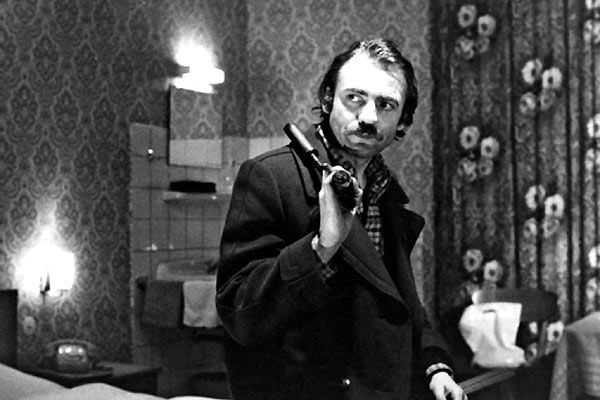 What's wrong with a cowboy in Hamburg?
"The Americans have colonized our subconscious" (Wenders in "Kings of the Road")
Bordwell, "The Art Cinema as a Mode of Film Practice" from Poetics of Cinema
Elsaesser, "American Friends: Hollywood Echoes in the New German Cinema"
Jarvie, "Free Trade as Cultural Threat: American Film and TV Exports in the Post-War Period"
Here is a mainstream review of the film from everyone's favorite middle-brow film critic, Roger Ebert.
Subscribe to:
Posts (Atom)


 Posts
Posts

