In the Cultural Resistance Reader read the short chapters in Section IV on "Subcultures and Primitive Rebels" --we will be discussing the subcultures profiled there as case studies in class as presented by you. Please finish the readings from Section III in the Reader as well.
Extra Reading: Dick Hebdige from Subculture: The Meaning of Style
Chapter 6 : Subculture: The Unnatural Break Chapter 7 : Style as Intentional Communication Chapter 8 : Style as Homology
from Democratic Republic of Congo: Konono No. 1 - Ditshe Tshiekutala Could this be an example of folk today?
from India: Ravi Shankar - Dhun But this is not 'folk music' as we defined it, rather it is an example of the 'high' in a different cultural and social context.
The virtuoso instrumentalist and composer as superstar: Franz Liszt.
Good interview on WNYC's Soundcheck with Tim Blanning author of The Triumph of Music, a 'social history' of musicians in the west and how they went from being considered merely servants to being 'stars'. This is an excellent example of metacontextual musical knowledge. Required listening.
These are two articles on videogames and their history. Use them in conjunction with the screening of Game On: The Unauthorized History of Video Games screened in class.
The question we have been discussing in class is: What makes mainstream media mainstream? How does this prevent the media from fulfilling the societal roles that liberal democratic theory assigns to it? I am including here readings which should be able to give you a nice understanding of the issues and the problems.
from Bob Lefsetz:
The content industries don't want a distinction between what's legal and
illegal, that bit them in the ass already, with the Home Recording Act
of 1992, wherein it was declared legal to make your own mixtapes, even
share them. That horrified them. So they changed their game, they
decided to go after the sharing itself.
That's what SOPA and PIPA are all about.
And the way they're going to achieve their goal is to put the burden of
policing upon Google and Yahoo and the other portals/search engines that
provide links. If the cost of policing is high enough, they'll just
outlaw the practice. Entirely.
There's a great analogy at the beginning of this clip. A story about a
bakery in Brooklyn that allowed customers to bring in their kids'
drawings so they could be imprinted upon cakes. Only one problem, kids
like to draw cartoon characters, the ones they see in movies and on
television. And this is copyright infringement. So what did the bakery
do? Instead of having someone make a judgment as to the legality of each
drawing, they outlawed the practice entirely. Now you can still get an
image on your cake, but it has to be one of the authorized ones the
bakery provides.
But maybe your kid drew a fish because he likes fish and he's never even
seen "Finding Nemo". He can't get his fish on a cake because the bakery
is afraid of infringement, they're not even gonna make that judgment.
Google is gonna outlaw links to all sharing because it's just too damn
expensive to figure out what's legal and what's illegal. So you'll just
consume pre-approved content, manufactured by the usual suspect music
and movie companies. You can't create your own because it might infringe
and Google doesn't want to make the wrong decision and it takes too
much money to make a decision, so you can create your music, but it
won't be findable, the search engine can't take that risk.
And if you think the above is blown out of proportion, you don't understand how the content companies think.
They want control. The Internet is their worst nightmare. It allows
anybody to create. And under the rubric of preventing you from mixing up
your content with theirs, they want to outlaw sharing completely, they
don't want you making music and movies, they just want you to buy
theirs. This is the concept of scarcity that made them so much dough,
this is the past they're trying to jet us all back into by crippling the
Internet. As Clay Shirky says in this video,they want to "raise the
cost of copyright compliance to the point where people simply get out of
the business of offering it as a capability to amateurs."
They think we're dumb. They've got no idea the Internet is all about
smart. They want us to believe in the nincompoops on "The Jersey Shore",
not some egghead with degrees who's actually thought about all this and
isn't in it for the short term money and fame.
TED talks are a burgeoning resource. The brand stands for intelligent
insight. Take the time out to watch this presentation, you'll get it,
you'll be horrified, you'll send it to all your friends.
P.S. You might be unable to do this under SOPA. For fear that you might
be sharing copyrighted material, your ability to share at all could be
crippled, because it would cost too much for the linking service to
determine whether it's legal to share the content or not.
These are the readings for the first weeks of class and discussion. Remember that we are still in the process of investigating the concept of 'new' media and trying to go beyond a mere chronology of new technologies in favor of a more nuanced and specific understanding of the truly 'new' aspects of digital converged media and the social potential/consequences from a politically progressive perspective --the 'what's new for society' question.
The articles here will introduce you to some of the more practical transformations that the appearance of digital technologies have produced in 'old' media like film and television. Please note that as we discussed in class, even in this case, the transformations are both smaller and larger than those one could imagine: on the one hand, the film and televisual experience is for the most part unchanged; on the other, however, the film medium and the specificity of the photo/cinematographic image has been dramatically transformed as it loses its indexicality and the medium goes from a synthetic to an analytic one while television's horizon ceases to be that of a regulated/national context to an open/transnational one.
from Frith & Goodwin (eds), On Record
-Adorno, "On Popular Music"
nb. You can find this essay together with "The Culture Industry: Enlightenment as Mass Deception" co-written with Max Horkheimer --an essay which if you have not read should definitely do so-- here.
from Even Eisenberg, The Recording Angel: Music Records and Culture from Aristotle to Zappa
-Eisenberg, Chapter 2: Music Becomes a Thing
Here is the study guide for your final exam as well as Susan Sontag's "Looking At War". This is the original version of the article as it appeared in The New Yorker. If you like what you read a good suggestion for your holidays is to get the expanded version as it appears in Regarding the Pain Others, the book that Sontag completed right before her death.
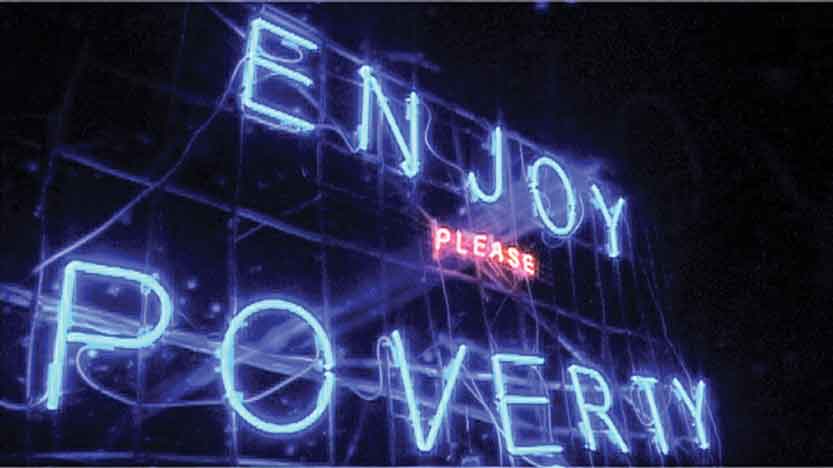
I am also including two articles on Enjoy Poverty itself (one of them is an interview with Renzo Martens).
The files and other media linked to and made available on this site are strictly for educational purposes and their use is therefore justified by the doctrine of fair use under the U.S. Copyright Act of 1976, 17 U.S.C. § 107. If, however, you are the legitimate copyright holder of the material found here and have --for whatever reason-- reservations about the FAIR USE of your so-called property I will gladly remove it. Files remain on-line for a very limited time period. If you find a dead link on old archived posts you're out of luck. You could try emailing me at peter [at] kinoppete [dot] org if you're desperate.
 In the Cultural Resistance Reader read the short chapters in Section IV on "Subcultures and Primitive Rebels" --we will be discussing the subcultures profiled there as case studies in class as presented by you. Please finish the readings from Section III in the Reader as well.




 Posts
Posts


