Sunday, June 12, 2011

De-Stalinization = De-Regulation?: Eastern European Mass Media


Articles on the passage from the state/party controlled monopolies of Eastern European nations to the commodified systems post-1989. Everyone should read these articles as background for preparing their presentations.

Kevin Williams - "The Media in Eastern Europe"

European Mass Media: Deregulation, Commodification and Neo-Television


Here are a number of articles to think through some of the more specific issues on the paradigm shift in European Broadcasting during the 1980s and 1990s and the consequent shift toward deregulation and privatization. The Ginsborg and Hibberd articles are specifically on the 'Italian case'. The articles by Umberto Eco and Raymond Williams are two theoretical and critical reflections on the aesthetic repercussions of liberalization on both programs and audiences. Relate these readings to our screening of Maurizio Nichetti's The Icicle Thief (Ladri di Saponette).


Paul Ginsborg, "The Making of a Television Empire"
from Ginsborg's Silvio Berlusconi: Television, Power, Patrimony (Verso, 2005)
from Bull & Rhodes, Italy: A Contested Polity (Routledge, 2009)

Umberto Eco, "A Guide to the Neo-Television of the 1980s"
from Williams, Television: Technology and Cultural Form (Routledge, 1990)

This just in:
From this week's The Economist, an article on Italy with an eloquent title if there ever was one: "The Man Who Screwed an Entire Country". Find the editorial here.

Please note that The Economist is the most respected European business weekly whose stance on economic policy can only be characterized as fanatically pro-business and pro-capitalism --in short the magazine is regarded as predominantly very conservative.
I point this out primarily to underline how basic thinking on the role, function and values of the mass media --particularly of the press-- manages to cross ideological lines. This puts the so-called Italian anomaly into perspective as an issue which is ultimately a populist and bipartisan one and not tied to specific ideological perspectives.


Saturday, June 4, 2011

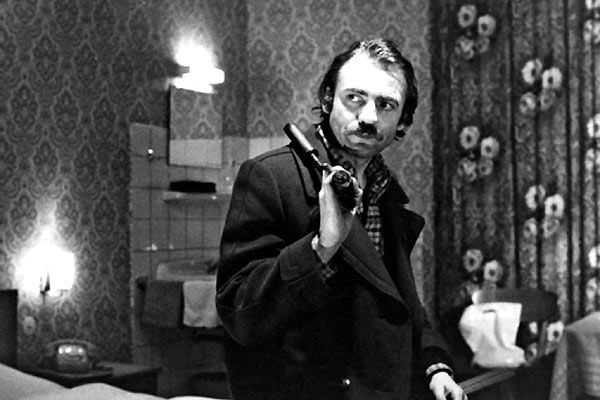
National Cinemas, Art Films, American Friends and Cultural Imperialism or, What's Wrong With A Cowboy in Hamburg?

What's wrong with a cowboy in Hamburg?
"The Americans have colonized our subconscious" (Wenders in "Kings of the Road")

Readings for this week's discussion on the concept of National Cinema, the Art Film and Wim Wenders' Der Amerikanische Freund (1977)

Bordwell, "The Art Cinema as a Mode of Film Practice" from Poetics of Cinema
Elsaesser, "American Friends: Hollywood Echoes in the New German Cinema"
Jarvie, "Free Trade as Cultural Threat: American Film and TV Exports in the Post-War Period"

Here is a mainstream review of the film from everyone's favorite middle-brow film critic, Roger Ebert.

Monday, May 30, 2011

'Free' or 'Pirate' Media?


Below is Hans Magnus Enzensberger's "Constituents of a Theory of the Media" where he discusses the concepts of 'emancipatory vs. repressive uses' of the media while offering a radical critique of traditional progressive conception of public/state media in favor of the 'new media' potentials of 'free' media. Hesmondalgh's article is a general reflection on the concept of alternative media, it's organization and the specific textual production.

Roger Chapman's article is a comparative analysis of the two main British 'pirate' radio stations, Radio London and Radio Caroline and how they differentiated themselves on the basis of their attitude to commercialism and their mission.

Finally John Downing writes on 'radical media' in Italy covering a number of activist situations and their use of new communication technologies by political movements during the late '60s and early '70s. This last article will be the clearest contextualization of Marco Tullio Giordana'sI Cento Passi.

Something to think about in relation to I Cento Passi is how Peppino Impastato's attempts at carving out a space for communication and direct political action (a public sphere within the confines of a small community dominated by organized crime and their ties to the political realm) is dramatized in the film --from traditional political rallies to 'free radio' after navigating dadaist street theater, pamphleteering, film screenings and be-ins. Think specifically of the characteristics of RadioAut --programming, control, voice, 'mission', etc.

Hesmondalgh, "Alternative Media, Alternative Texts?"
Enzensberger, "Constituents of a Theory of the Media"
Chapman, "The 1960s Pirates: A Comparative Analysis of Radio Caroline and Radio London"

Downing, "Radical Media in Italy" from Radical Media


Wednesday, May 25, 2011

Public Service Broadcasting: Ises and Oughts


Here are the final readings for this week. Concentrate your reflections on the concept of PSB (public service broadcasting), it's features, criteria and justifications.

from Humphreys, Mass Media and Media Policy in Western Europe
Chapter 3: Press Concentration in Western Europe
Chapter 4: European Public-Service Broadcasting System

Richard Collins, "'Ises' and 'Oughts': Public Service Broadcasting in Europe"
from Allen & Hill (eds), The Television Studies Reader (Routledge, 2004)


Monday, May 23, 2011

European Societies and Media Culture

from Humphreys, Mass Media and Media Policy in Western Europe
Intro + Chapter 1: Press Freedom: The Free Market and the Development of the Modern Press
Chapter 2: Press Freedom and its Limits: The State, the Law and the Private Individual

from Williams, European Media Studies
Chapter 1: The European Media Landscape
Chapter 2: The Press in Europe

Sunday, May 22, 2011

Welcome To Summer I 2011


Welcome to Summer I: for this session the blog is exclusively dedicated to the CMS 315 European Mass Media class. Please check back often to find readings, bits of information taken from the internet together with breaking news and current issues that we can use for class discussion.

Thursday, April 21, 2011

Sunday, April 17, 2011

(Final) Popular Music Readings


Assuming that at this point you are (basically) all done with the Garofalo textbook, here are the reading assignments up to the end of the semester:

On 'co-optation':
Thomas Frank's "Commodify Your Dissent" here.

On Jamaican Music:
from Dick Hebdige, Cut'n'Mix here.

On Gender:
Simon Frith and Angela McRobbie, "Rock and Sexuality"
Simon Frith, "Afterthoughts
"Richard Dyer, "In Defense of Disco"
Find these articles here as a single PDF file.


On 'sub-cultures':
Here are the Dick Hebdige chapters from Subculture: The Meaning of Style. Refer back to the Punk: Attitude film screening.


The Ramones, "Do You Remember Rock'n'Roll Radio?" Live in Rome, 1980


On sampling, mash-ups and the 'postmodern turn':
Andrew Goodwin, "Sample and Hold"
E Ann Kaplan, "A Postmodern Play of the Signifier?" (Fixed Link Now)
Negativland, "from Wired: Negativland Interviews U2's The Edge"

Also, to clarify (or further obscure) 'postmodernism' please help yourself --in case you have not encountered it in your other studies-- to Fredric Jameson's "Postmodernism and Consumer Society"

There will be two further articles specifically on hip-hop culture and post-Napster music industry.

The Democratic Right To Know

James Boyle from The Public Domain: Enclosing the Commons of the Mind
Link above is for the whole book which Boyle made available through the Creative Commons License. You should read Chapter 6: I Got A Mashup.
If you don't want to download the whole book you can find a link to the annotatable online version of the chapter here.

Matt Mason - We Invented The Remix

Aoki, Boyle and Jenkins - Bound By Law?
This is a comic book on copyright. Don't be fooled by it's form: it's a great read and I strongly encourage you to read at least the first 15 pages.
You can also find it free on-line from its publisher --crazy, huh?-- Duke University and The Center for the Study of the Public Domain in a variety of formats. You can also 'remix' it and you're encouraged to translate it. It's all here.

From The Cultural Resistance Reader: please have the articles in Section Seven read. The following articles from Section 8 are also required: Jordan on 'Reclaim the Streets'; Jason Grote on 'Revered Billy' and Ricardo Dominguez's 'Electronic Disturbance'

Bonus:

This is an old post from the blog where you can find a link to download Girl Talk's Feed The Animals.

Did I mention that the following Jenkins article is something that you should read?

Saturday, April 9, 2011

Convergence Culture & Resistance

Map of the Internet, circa 2003 (Source The Opte Project)

Required readings:


(includes Linus Torvalds' Preface to The Hacker Ethic, "What Makes Hackers Tick?")
Wark, "The Hacker Manifesto"

The following are recommended readings that some of you might have already encountered in other classes. If you have not, I highly encourage you to read these as they provide a wealth of contextual information and integrate many of the concepts that we are at present discussing in class particularly in relation to the 'new' mediated environments that surround us.

Monday, March 28, 2011

The Audience Strikes Back


For Those About To Rock: Return of the Aura

Frank Zappa & Captain Beefheart

Here are a couple of articles to integrate Keightley's Reconsidering Rock article. The first Frith article is required; the second article is a highly recommended read. Enjoy the Lester Bangs reviews from Creem and Garofalo's article on Soul.

Simon Frith - "Rock and Popular Culture"
Simon Frith - "The Magic The Can Set You Free": The Ideology of Folk and the Myth of the Rock Community
Paul Clarke - "'A Magic Science': Rock Music as a Recording Art"
Lester Bangs - Various Record Reviews from Psychotic Reactions and Carburetor Dung
Reebee Garofalo - Popular Music and the Civil Rights Movement

Also, here is Andrew Chester's "For A Rock Aesthetic", Richard Merton's response, "Comments" and Chester's response to the response, "Second Thoughts on a Rock Aesthetic: The Band". It's all here at this link --the whole epochal exchange in one handy location.

Please read in 'Rocking Out' up to and including Chapter 8.
Let There Be Rock: Reverend Bon tells you all about it. As you can see the 'aura' is back around Angus' head.
AC/DC, Let There Be Rock (1977):

Co-Optation and The Implosion of Meaning: Slackers

Every single commodity you produce is a piece of your own death.

From Section Seven on "Commodities and Co-optation" please read:

Theodor Adorno, "On the Fetish-Character in Music and the Regression in Listening"
Richard Hoggart from The Uses of Literacy
Malcolm Cowley from Exile's Return
Thomas Frank, "Why Johnny Can't Dissent"

The Hoffman ("Revolution for the Hell of It") and Rubin ("Do It!") you can read 'for the Hell of it'.

Return to Section Three, "A Politics That Doesn't Look Like Politics" please (re)read:

Adolph Reed, Jr., "Why Is There No Black Political Movement?"
Jean Baudrillard, "The Masses: The Implosion of the Social in the Media"
Hakim Bey from TAZ: The Temporary Autonomous Zone
Simon Reynolds from Generation Ecstasy
+ the account of 'a lynching in 1920'

The complete version of Baudrillard's "The Masses: The Implosion of the Social in the Media" is here.


Additional Recommended Baudrillard Readings:

Jean Baudrillard, Requiem for the Media
Jean Baudrillard, The Implosion of Meaning in the Media from Simulacra and Simulation

Also, and finally, here's the chapter from Cold World: The Aesthetics of Dejection and the Politics of Militant Dysphoria by Dominic Fox on Black/Death Metal: "A Sermon in the Name of Death"